
How to calculate PRIIPs KID indicators under ESMA rules?

Estimated read time: 3 minutes Since the introduction of the PRIIPs framework for Key Information Documents (KIDs), as set out in Commission Delegated Regulation (EU) 2017/653 and further refined in Commission Delegated Regulation (EU) 2021/2268, asset managers are required to publish and periodically update these documents. In practice, regulators observe that KIDs are often missing, […]
How to perform Liquidity Stress Testing under ESMA rules?

Estimated read time: 8 minutes Liquidity Stress Testing (LST) has been a core regulatory requirement for asset managers since the introduction of the ESMA Guidelines in 2020. It plays a key role in assessing whether a fund can meet its obligations under both normal and stressed conditions. With the introduction of new Liquidity Management Tool […]
How Fund Managers Should Approach ESMA’s New LMT Guidelines

Estimated read time: 6 minutes What you need to know The European Securities and Markets Authority (ESMA) has introduced new guidelines that require UCITS and AIFMs to take a much more practical and fund-specific approach to choosing Liquidity Management Tools (LMTs). The aim is simple: improve how funds manage liquidity risks and reduce the chances of […]
How do banks select macroeconomic drivers in IFRS 9 models?

Banks are required to estimate credit risk in a forward-looking manner, particularly under the IFRS 9 regulatory framework. A key component of this process is the calculation of Expected Credit Losses, where default probabilities need to reflect current and expected economic conditions rather than long-term averages. In practice, this requires a transition from Through-the-Cycle probabilities […]
How reliable are KID performance scenarios?

European fund managers are required to include performance scenarios in Key Information Documents (KIDs), following the methodology prescribed by ESMA. These scenarios provide investors with an indication of potential future returns and are therefore an important part of investment decision-making.At Amsshare, we perform these calculations for fund managers as part of regulatory requirements. At the […]
Real-life example: Adyen’s cost of equity

Estimating the cost of equity is a key step in financial analysis, particularly in valuation and investment decision-making. A central component in this process is beta, which measures how sensitive a company is to market movements. In practice, it is important to understand how beta is constructed, and how factors such as leverage influence the […]
How do derivatives help manage market risk?

Managing market risk is an important aspect of working with financial assets. Changes in underlying prices can have a significant impact on the value of investments, making it essential to understand how these risks can be measured and controlled. Derivatives provide a flexible way to adjust risk exposures without directly changing the underlying positions. At […]
Why investors don’t always act rationally

Decision-making under uncertainty is a central topic in finance, influencing how investors evaluate risk and return. Traditional financial theory assumes that individuals behave rationally and consistently when making decisions. However, empirical evidence suggests that real-world behaviour often deviates from these assumptions. At Amsshare, we analyse financial models and behavioural patterns that influence investment decisions. Understanding […]
Understanding Order Driven Markets
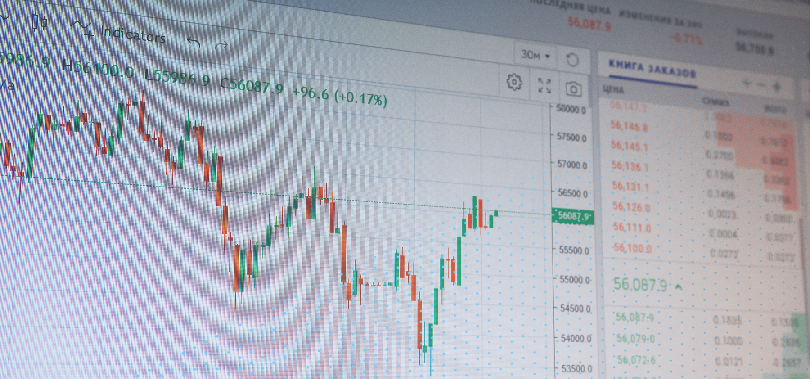
Financial markets rely on efficient transaction processing to ensure that buy and sell orders are executed in a timely and transparent manner. In practice, however, real-world markets are characterised by various frictions and inefficiencies that influence how trades are executed and how prices are formed. At Amsshare, we develop and implement financial models that depend […]
How do you price a derivative?

Derivatives play a fundamental role in modern financial markets, offering investors tools to manage risk, enhance returns and structure complex investment strategies. Among these instruments, options are particularly important due to their flexibility and wide range of applications. At Amsshare, we frequently work with financial models that incorporate derivatives and option pricing techniques. Given their […]