
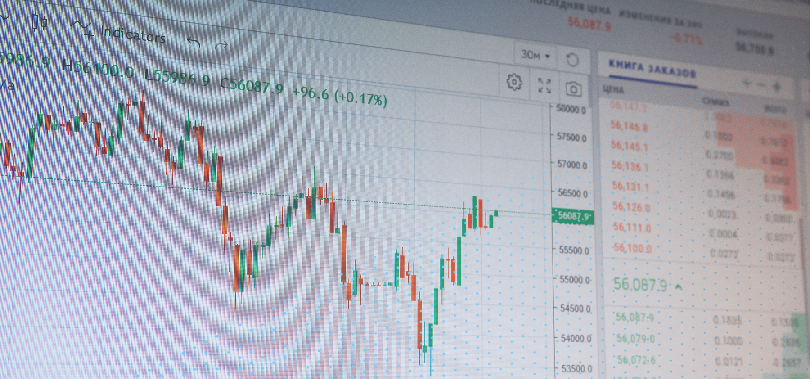
Financial markets rely on efficient transaction processing to ensure that buy and sell orders are executed in a timely and transparent manner. In practice, however, real-world markets are characterised by various frictions and inefficiencies that influence how trades are executed and how prices are formed.
At Amsshare, we develop and implement financial models that depend on accurate transaction data and a clear understanding of market structure. Insight into how transactions are processed and how different market mechanisms operate is therefore essential. This article provides a practical overview of how equity exchanges function and how orders are matched in modern markets.
Summary
This article introduces transaction processing on equity exchanges and highlights the frictions and inefficiencies present in real-world markets. It explains the two main types of market structures, quote-driven markets and order-driven markets, with a particular focus on the latter.
In an order-driven market, buyers and sellers submit orders to a central order book, where trades are matched based on price and time priority. The article discusses the concept of the bid-ask spread, the role of brokers as intermediaries and the importance of a continuous flow of orders for maintaining liquidity.
Two primary order types are examined: market orders and limit orders, both of which are stored and executed through a limit order book. The article also includes visual representations of theoretical and live order books to illustrate how these mechanisms function in practice.
The article concludes by highlighting the advantages of order-driven markets, including increased transparency, lower costs compared to quote-driven markets and greater flexibility in order execution. These insights are directly relevant to how Amsshare analyses market behaviour and develops financial models that rely on accurate transaction data.