

Estimated read time: 3 minutes
That is not surprising. The KID is not just a disclosure document, but the outcome of a highly prescribed methodology. Risk, performance and costs all have to be calculated in a specific way. With increasing regulatory scrutiny, it has become essential to apply these rules consistently, update KID indicators on time and ensure correct publication.
The importance of KIDs
KIDs were introduced to improve comparability between investment products within a harmonised European framework. By using a standard format and common calculation methodology, they allow investors to assess different products on a consistent basis.
This standardisation plays a key role in improving transparency, giving investors clearer insight into:
- The risk profile of a portfolio
- Potential performance under different market scenarios
- The impact of costs on investment results
This makes the KID an important bridge between complex portfolio construction and investor-friendly disclosure. Its value depends on whether the figures are calculated correctly and kept up to date.
Key metrics and methodology
The quantitative foundation of the KID is built around a number of core indicators that together provide insight into risk, performance and cost.
At the core of the KID is the Summary Risk Indicator (SRI), shown on a scale from 1 to 7. The SRI is derived from two underlying components: market risk and credit risk.
- Market risk is measured through the Market Risk Measure (MRM). For many products, this is based on the Value-at-Risk Equivalent Volatility (VEV), which translates downside risk into a volatility-based metric that can be mapped to a risk class.
- Credit risk is captured through the Credit Risk Measure (CRM). This is typically linked to the creditworthiness of the issuer or obligor and is often based on external credit ratings, such as those from S&P, Moody’s or Fitch. The final SRI is determined by combining MRM and CRM using the prescribed regulatory matrix.
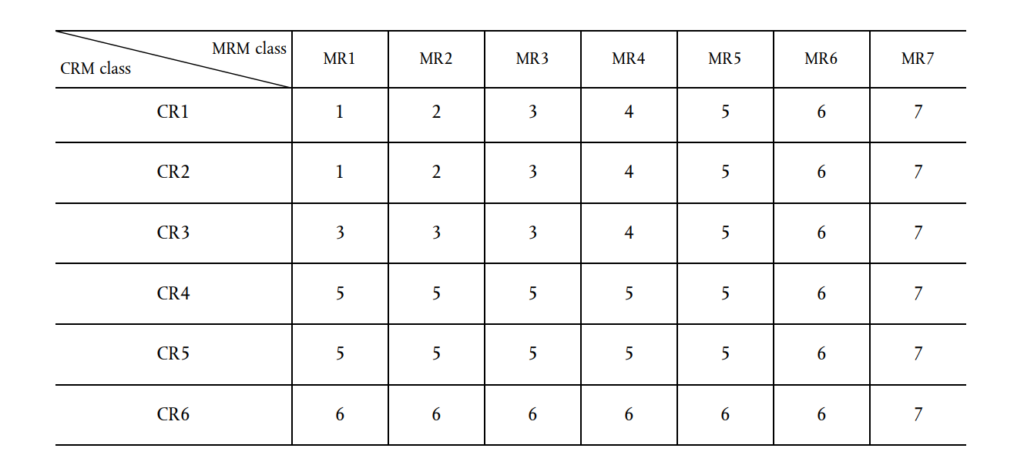
Source: Commission Delegated Regulation (EU) 2017/653
Performance scenarios are another key element of the KID. These scenarios – stress, unfavourable, moderate and favourable – illustrate how a product may perform under different market conditions. They must be recalculated on a monthly basis using prescribed methodologies. While outcomes do not always change significantly from month to month, the requirement ensures the figures remain aligned with the most recent market data.
Costs also play an important role. The KID shows the reduction in return caused by costs over time, based on standardised assumptions. This includes both direct costs (such as entry or management fees) and indirect costs, such as transaction costs. The methodology also reflects the opportunity cost of these fees, meaning the impact of returns that could have been generated if those costs had not been incurred.
Towards a structured workflow approach
KID requirements demand consistent application of methodology, regular updates and full reproducibility. With increasing regulatory focus, this has become essential.
At Amsshare, we have embedded the full PRIIPs methodology into a structured workflow that goes beyond calculation. KID indicators are updated within seconds and automatically interpreted, highlighting key changes, risk movements and points of attention. This ensures compliance while directly supporting decision-making.
You can read more here about how these workflows are developed.
Curious how to stay compliant without manual effort? Feel free to get in touch.